Franco Mabanta and his media network: Journalism but for what purpose?
MEDIA COMPANIES in the Philippines operate without government accreditation. City hall may require a business license to sell the newspaper or magazine, including the ad space. But this does not involve the selection and publication of news content.
In the age of the Internet, individual news providers are free to create their own platforms on the wide wide web, much like what speakers on makeshift platforms used to do in public squares.
The case of Peanut Gallery Media Network (PGMN) exemplifies the media system for what it is, an arena where one must compete for a share of media market and its measure of public attention.
PGMN’s experience reveals a sinister side of media activity.
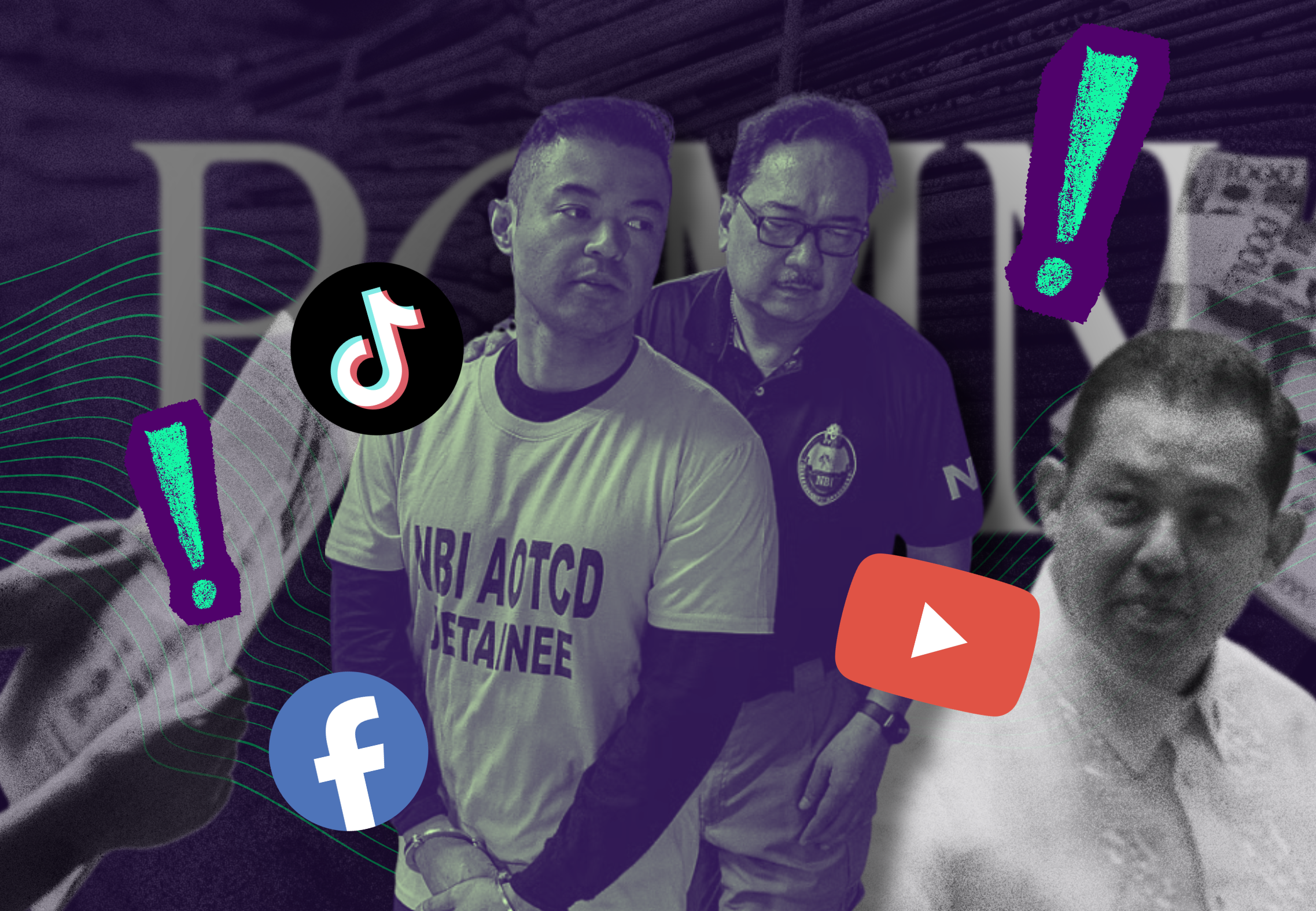
The company’s founder, Franco Mabanta, was arrested on May 5, by the National Bureau of Investigation (NBI) for his alleged attempt to extort PHP 300 million from Leyte 1st District Representative Martin Romualdez in exchange for withholding the release of an exposé linking the latter to flood control anomalies.
PGMN employees Ericson James Pacaba, John Alexander Vasquez Gomez, Jardine Christian Requio Serrano, and Franco Jose Gallardo were also detained and all have been released on bail.
Supporters of PGMN condemned the arrest and claimed the action as a violation of press freedom and an attack against autonomy of the press.
Media experts and academics acknowledge the need to await results of the criminal investigation, a process that raises questions about media practice in the Philippines and its observance of professional standards and ethical practice.
“Not a press freedom issue”
The constitutional protection of media does not include crime. Extortion and blackmail must be investigated fully as criminal activity. The use of news content to achieve blackmail does not gain perpetrators any special protection. The case has revealed the wide net that captures all kinds of media activities, including those perpetrated by criminals.
In several interviews aired across media networks, Professor Danilo Arao of the College of Mass Communication, University of the Philippines Diliman, emphasized that the arrest of Mabanta should not be characterized as a press freedom issue. He argued that responsible media organizations do not engage in secretive cash transactions or extortion. Arao also questioned the legitimacy of Mabanta’s “media network.”
Center for Media Freedom and Responsibility (CMFR) Trustee Vergel Santos echoed similar insights. In an interview with OneNews PH on May 6, Santos said Mabanta, who operates on alternative platforms, can be considered a media practitioner. However, he emphasized a key principle of press freedom which mandates that verified information of urgent public interest must be published promptly, a reminder that so much of the information had happened some years ago. Santos also questioned whether the information in the supposed exposé was indeed newsworthy.
PGMN’s questionable practices
PGMN describes itself as a “media channel” that positions free speech absolutism at the core of its identity. The network boasts as an open space for diverse voices and perspectives, with a promise “to never censor.” The Youtube channel airs content that leans heavily on political commentary and analysis of social issues. Its “anchors” and “hosts” are largely composed of social media personalities and influencers, not members of media with news experience. While their website contains news content, these are posted without bylines. The website does not name the editors in charge. Mabanta, as its founder and chairperson, has no background in journalism nor any experience in a news company.
The claim for openness to all kinds of content should serve as a warning, alerting the public to the quality of what it offers. As some respected American broadcast journalists put it, “Journalism is an edited process.”
Media reports were correct to point out some concerns about PGMN, mainly concerned with the independence of its management.
Early reports from Rappler, ABS-CBN News Online, and Inquirer.net on May 6 identified Mabanta, not as a journalist or news publisher, but as a “social media personality” who owned PGMN.
In a separate article published on May 7, Rappler examined Mabanta’s background by probing his political affiliations. It recalled his role as a political strategist, his connection to “UniTeam” or the Marcos-Duterte camp during the 2022 national elections. After the Marcos-Duterte split, Mabanta confirmed himself as a Duterte supporter.
By reviewing Mabanta’s political background, the report set apart journalism provided by independent news companies from news content of partisan media produced for its own political agenda. PGMN content has to be acknowledged and understood as political propaganda, presented mostly by social media influencers and media personalities, not practicing journalists whose daily work submits to editorial review.
Reporting on Mabanta and PGMN
After the initial coverage on May 5, TV news picked up on the debate over whether the arrest of Mabanta involved a curtailment of press freedom. News included this development in all its programs throughout the day.
In an ANC interview with Karmina Constantino on May 6, Arao outlined that PGMN’s content primarily centered on commentary and news analysis, expressing concerns over the network’s airing of allegedly unverified or “insinuative” material that falls short of journalistic standards.
GMA Public Affairs’ Just Facts episode on May 13 featured a discussion on YouTube with Arao and Rico Domingo, Chairman of Movement Against Disinformation, who warned about the speed with which social media spreads narratives, including false or unverified accounts. Domingo also stressed that access to a media platform does not automatically confer journalistic status to a media personality, emphasizing that journalism observes ethical rules and protocols.
PGMN has exemplified the perils confronting news programs as these adjust to the demands of digital platforms. Rappler’s Decoded piece, released on May 18, traced PGMN’s history and emergence as a digital-first news outlet. It highlighted the use of Facebook, YouTube, and TikTok as channels designed to gain, not just optimal revenues from advertising income, but to maximize its political influence. Rappler argued that independent journalism should check against the influence of political as well as personal interests on the news agenda.
The ethical concerns are obvious when news programs are driven by goals set by profit or politics. Commercial gains can overwhelm news values in editorial practice. Political and partisan goals also exert similar pressures and journalists must be prepared to check the impact of these forces.
The situation calls for stronger levels of media literacy on the part of the public, enabling them to detect unchecked goals for commercial profit or partisan objectives.
The availability of media platforms calls for a more discerning public; the audience must gain the capacity to detect commercial profit or partisan motives in the presentation of news. Media literacy enables the public to discern how news programs are set apart by their adherence to the principles of journalism.
Leave a Reply