Under fire and in the dark: Media coverage of the Senate lockdown fiasco and the hunt for a fugitive senator
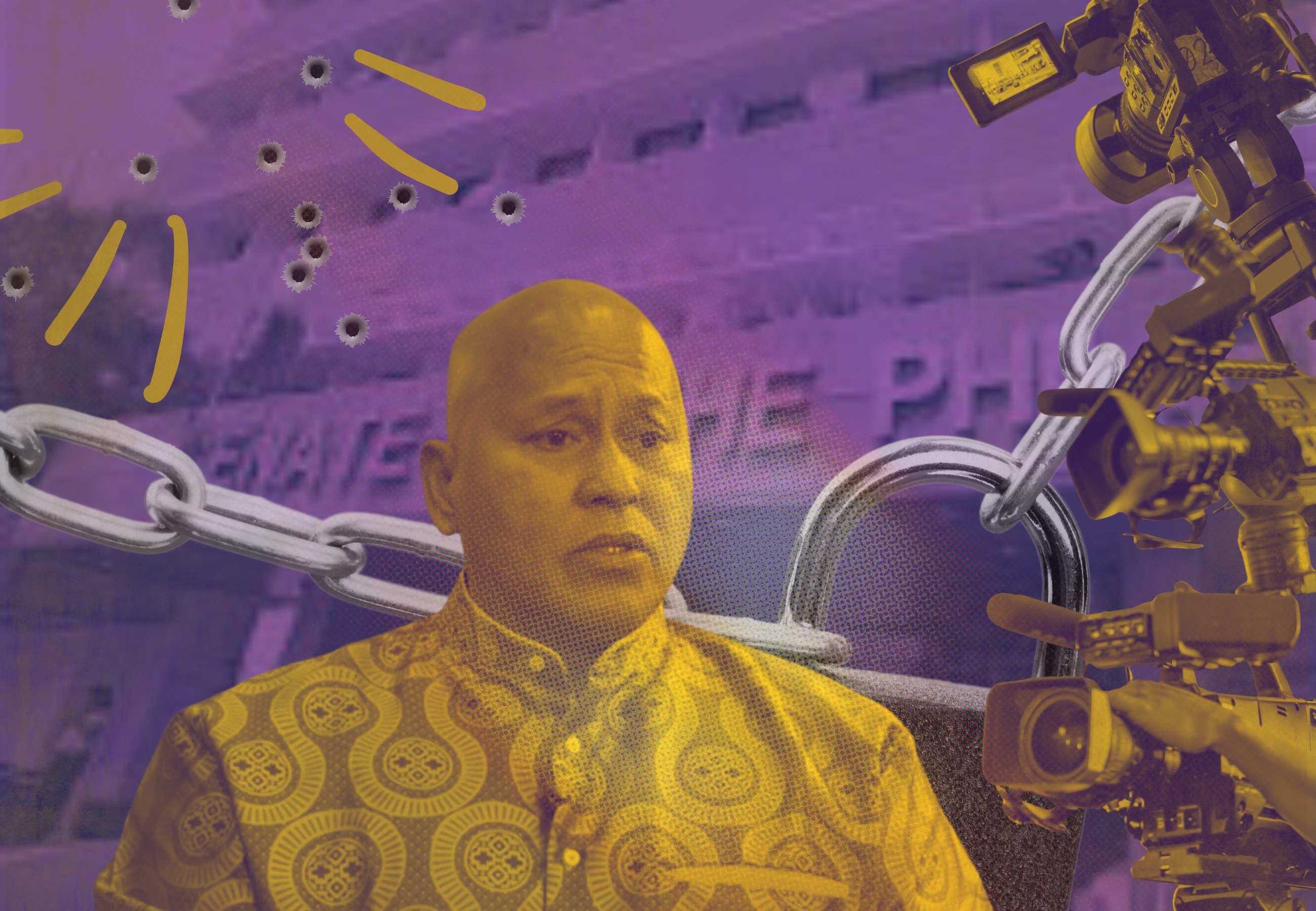
FROM MAY 11 to 14, 2026, chaos transformed the Philippine Senate into a theater for a first-ever occurrence in the country’s political history—the physical and institutional meltdown of the upper chamber of Congress. Wanted by the International Criminal Court (ICC) for crimes against humanity, Senator Ronald “Bato” dela Rosa made a sudden appearance in the legislative halls, flanked by his political allies. What followed was an unprecedented jurisdictional standoff: a tense confrontation erupted between waiting law enforcement officers and a rapidly assembled Senate security team.
As broadcast media carried a flurry of conflicting statements from various state offices, the situation deteriorated on the night of Wednesday, May 13, when sudden gunshots echoed through the darkened, locked-down halls. Amid the chaos, the Philippine press corps found themselves reporting live on the state of the Senate under physical siege.
This monitor examines how major news organizations mapped the flow of activities, worked to untangle the state’s contradictions, and demonstrated unparalleled bravery on the ground, even as the target of the hunt managed to slip through the cracks of the congressional walls.
What happened?
The crisis began on the morning of Monday, May 11, 2026, when Senator Bato dela Rosa abruptly returned to the Senate after a six-month evasion of public view.
Before any formal protective orders were ironed out by legislative lawyers, Dela Rosa encountered individuals identifying as National Bureau of Investigation (NBI) agents waiting in the corridors. He resisted apprehension on the spot, later telling journalists that he broke free and ran. Seeking immediate shelter, Dela Rosa retreated into the main chambers where Senate President Alan Peter Cayetano officially granted him Senate protective custody at approximately 12:00 PM. Cayetano justified the move by claiming that a foreign ICC warrant cannot be executed on Philippine soil without a corresponding domestic court order.
By Wednesday night, May 13, rumors of an imminent National Bureau of Investigation (NBI) arrest operation triggered a frantic security lockdown. Tensions reached a boiling point when Acting Senate Sergeant-at-Arms Mao Aplasca warned journalists of a five-minute countdown to a complete shutdown, followed shortly by the sound of gunfire inside the complex. In the ensuing confusion, Malacañang and the NBI denied ordering an arrest, while Aplasca later admitted that warning shots were fired. By the early hours of Thursday, May 14, Dela Rosa had vanished from the building. CCTV footage unmasked by the media later revealed that Dela Rosa slipped past security barriers at 2:30 AM, exiting the compound in a white van registered to Senator Robin Padilla.
What the media did?
The press corps reported on the Senate crisis under direct threat to their safety, remaining in position as armed security personnel moved erratically through the darkened corridors.
Composure under fire
When the lights were cut and gunshots rang out, the Senate press corps did not abandon their posts. Reporters across all major networks maintained an essential professional calm, continuing to anchor live feeds, file real-time dispatches, and document the chaos while taking cover at the same time.
This collective bravery drew widespread praise from the public. Social media was filled with expressions of support for the journalists on the frontlines. Some netizens singled out several women journalists for their exceptional composure during live, audio-interrupted broadcasts. The continuous reporting of Victoria Tulad (GMA Integrated News), Maeanne Los Baños (TV5), and Zyann Ambrosio (ABS-CBN News) captured the state’s erratic security failures as they happened.
Comprehensive timelines and analytical deconstructions
Once the immediate physical danger subsided, newsrooms pivoted from breaking coverage to exhaustive investigative documentation to expose the collapse of state coordination:
- ABS-CBN News, News5, Sunstar, and The Philippine Star produced timelines to make sense of the chaos.
- Rappler compiled its reports featuring complete granular timelines tracking Dela Rosa’s sudden appearance through the sequences leading to the lockdown. It also mapped the disinformation online around the incident. Rappler gathered legal luminaries, mining their expertise to help inform the public about the meaning of the events, both Dela Rosa’s appearance and subsequent disappearance.
- TV5’s Frontline Tonight provided crucial statutory clarity through a dedicated “News Explained” broadcast segment analyzing the legality of the ICC warrant. The report broke down how Philippine domestic laws, specifically Republic Act 9851 (The Philippine Act on Crimes Against International Humanitarian Law, Genocide, and Other Crimes Against Humanity), actually complement international obligations, demonstrating that the warrant possessed a valid legal foundation despite assertions from Senate leadership.
Unearthing the proof: The CCTV trail
The media refused to accept the initial political rhetoric from Senate President Cayetano, who downplayed Dela Rosa’s departure by stating the word “escape” was incorrect because the senator was simply “free to go.”
A crucial breakthrough came via broadcast journalist Arnold Clavio, who published CCTV footage revealing that Dela Rosa and Senator Robin Padilla were together in the Senate parking lot moments before Dela Rosa made his exit.
Following this lead, media focused its reporting on the subsequent Philippine National Police (PNP) and NBI press briefings. Reports published definitive details showing that at 2:32 AM on May 14, a white Toyota van registered to Robin Padilla was captured on driving Dela Rosa out of the compound.
Through these precise visual and logistical confirmations, the media successfully disproved early attempts by Senate leadership to downplay the escape.
Extracting answers: The Jessica Soho feature
Kapuso Mo, Jessica Soho’s May 17 report included a clear analysis of Senator Dela Rosa’s true intentions and legal strategy. In a May 13 interview, veteran journalist Jessica Soho, through a conversational but calculated approach, interviewed Dela Rosa, giving him time and space to speak, and allowing him to lay bare his bold defiance of the law.
During the exclusive interview, Dela Rosa openly admitted to evading law enforcement inside the Senate on Monday, recounting, “Hinawakan ‘yung braso ko, pumiglas ako… takbo na ako.” By prompting him to explain his sudden reappearance after a six-month absence, the interview exposed the political maneuvering behind his return. Dela Rosa admitted that he was personally called back by Senate President Alan Peter Cayetano because the minority faction planned to regain the Senate majority, and he was the crucial, deciding vote.
Conclusion
The media’s aggressive and unyielding coverage of the Senate fiasco succeeded in showing the political interests governing the Senate, whose leaders were more concerned about the extra vote that Dela Rosa could make to ensure a win for Alan Peter Cayetano’s bid for leadership, even if this objective involved sheltering a fugitive inside a government building.
By exposing how public resources and state security were manipulated to assist an escape, and by pointing out the glaring contradictions among various government agencies, the press prevented the state from quietly sweeping the self-interested politicking under the rug.
These developments should be appreciated by the public for what they showed directly, and made even more critical following the Supreme Court’s recent 9-5-1 vote denying Senator Dela Rosa’s request for a temporary restraining order (TRO). With the high court refusing to block his arrest and Malacañang affirming that the ICC warrant is valid under domestic laws, the call for accountability remains a paramount issue. Media’s relentless tracking of Dela Rosa’s timeline and whereabouts provides the kind of information that should help the public uphold the value in assessing the actions of senate members and their worthiness of people’s support.
Meanwhile, the tenacity that media have shown to follow up on these developments strengthens the guardrails that ensure justice for thousands of families who lost their loved ones to the violent killings of the drug war.
Journalism is a force that can make a difference in this particular fight for justice. The victims of the past can be part of many stories moving forward. Their stories should be recalled, their tragedies always timely, becoming worthy of note when the state stalls or fails to provide justice.
Leave a Reply