Resorts World Manila Attack: Cautious Coverage of a Confusing Incident
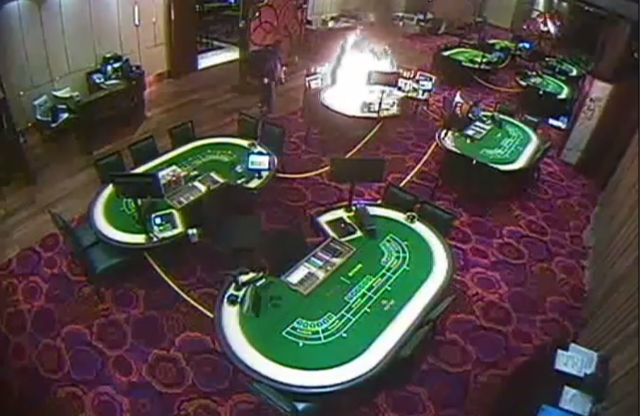
Screengrab from a video posted in the official Facebook Page of Resorts World Manila.
THE MEDIA’S job is to inform the public, as accurately and as quickly as possible. In case of an attack — such as what happened in Resorts World Manila shortly after midnight of June 2 — it is the media that the public relies on for information.
A few minutes after midnight of June 2, a lone gunman entered the gaming area of Resorts World Manila and started burning casino tables. Though the police was quick to respond, it took them a few hours to clear the hotel of guests and find the gunman. Later investigation would reveal that after burning casino tables, he went to the cashiers’ room and took a bagful of gaming chips, holed himself up in a hotel room, and shot and burned himself to death. Thirty-eight people were dead, including the gunman.
As a breaking news story, the Resorts World Manila incident was not an easy one to cover. There was little information available in the early hours of the incident, and sources gave conflicting information. Eyewitnesses recounted hearing shouts of “ISIS!” and of black-clad men with guns; Philippine National Police Chief Director Ronald dela Rosa initially said there was only one fatality, the gunman.
In a situation like this, media coverage is instrumental both in keeping the public informed and, at the same time, calm. Breaking news stories are often prone to mistakes, as accuracy is sometimes sacrificed for the sake of speed. When the story involves the possibility of a terror attack, the media’s obligation to report the news as accurately and as quickly as possible is paramount.
CMFR monitored reports from the newspapers Manila Bulletin, the Philippine Daily Inquirer, The Philippine Star, The Daily Tribune, Malaya, Manila Standard, and The Manila Times; news programs 24 Oras (GMA-7), Aksyon (TV5), News Night (CNN Philippines), TV Patrol (ABS-CBN 2); as well as selected news websites from June 2 to 5, 2017.
Following a developing story
As expected, it was broadcast and social media that broke the news about the Resorts World Manila attack. The initial news reports had little details beyond the fact that an armed man was inside the casino and smoke was coming out of the building. The police were tightlipped and so was the hotel management. As a result, many of the news stories focused more on eyewitness accounts, based on interviews with the panicked guests. Some of the official social media pages of the news organizations referred to or reposted social media accounts of some of the casino guests or of their friends and relatives.
The initial confusion was over the casualties of the attack and the gunman’s motive. By Friday evening, however, many of the details had been clarified so that by weekend, the news reports were focused on the results of the police investigation. There was only one gunman, identified as Jessie Carlos, a former tax specialist of the Finance department. The police said Carlos, who was dismissed in 2014 for unexplained wealth, was an inveterate gambler, so “addicted” to gambling his family had him banned from entering casinos. He had tried but failed to gamble in Resorts World Manila a few weeks before the attack. Most of the victims died from smoke inhalation; the police denied an earlier report that said some sustained gunshot wounds.
The coverage featured accounts by police authorities, Resorts World Manila officials, senators and congressmen, as well as witnesses and families affected by the incident.
Exploring the terrorism angle: Missing insights
Coming as it did on the heels of intense clashes in Marawi City between the Philippine military and an ISIS-inspired local terror group, and the subsequent declaration of martial law over Mindanao, the Resorts World Manila attack heightened tensions in the capital and fueled speculations about the possible expansion nationwide of the declaration of martial law.
Was it a terrorist attack? This is the question that reporters asked the police almost every hour, if not more often, in the first few hours after the attack. The question continued to be asked, though less frequently, in the days that followed. An account by US-based SITE Intelligence Group, which said a Filipino operative of ISIS claimed responsibility for the attack, was quickly picked up but news organizations also carried denials by local police.
Two days after the incident, House Speaker Pantaleon Alvarez issued a statement saying he believed the incident was an example of a “lone wolf terrorist attack targeting civilians to inflict maximum loss of life and damage to property.” Even US President Donald Trump called the incident a “terrorist attack.” A report by Rappler took note of the discrepancies (“Officials contradict each other on Resorts World Manila attack”).
Despite these, media were careful not to play up the terrorism angle. Many of the news reports were straightforward, careful to carry both the news source’s opinion that it was a terror attack and the official statements claiming otherwise. References to the Marawi conflict were mentioned for added context.
However, media lost an opportunity to further educate the public about terrorism when it failed to examine more deeply the explanations offered by police authorities in ruling out terrorism. The police’s brief overview listed a few characteristics that make an act terrorist and differentiated ordinary criminal acts from terrorist ones. But this information did not appear in reports.
Rappler, which was pilloried in the social media for running a story that an ISIS-inspired operative had claimed responsibility, carried more in-depth stories. It argued that an act of terror “is not defined by the use of gunfire or by a huge number of deaths,” which were among the reasons given by the police as to why the incident was not a terror attack. In the same piece, Rappler also cited insights from terror analyst Sydney Jones in 2013 who said “there is no single definition of terrorism,” and that terrorism “is a tactic, not an end in itself, involving a deliberate effort to create a sense of fear in a particular target population to achieve a political objective.”
Terrorism is a relevant yet complex topic that the media must discuss both intelligently and cautiously. Given the tragic incident in Resorts World Manila and the Marawi conflict, the press must step up its game in reporting similar incidents to help educate and inform the public at a time when the so-called “the fog of war” obscures details and hinders intelligent discussions.
Leave a Reply